18 April 2026
Champion joins UNESCO report launch: “Learning today, shaping tomorrow: Excellence and equity through youth skills”
Former WorldSkills Champions Trust representative for the MENA region, Yousra Assali, took part in a round table to launch the regional report focusing on the Maghreb.
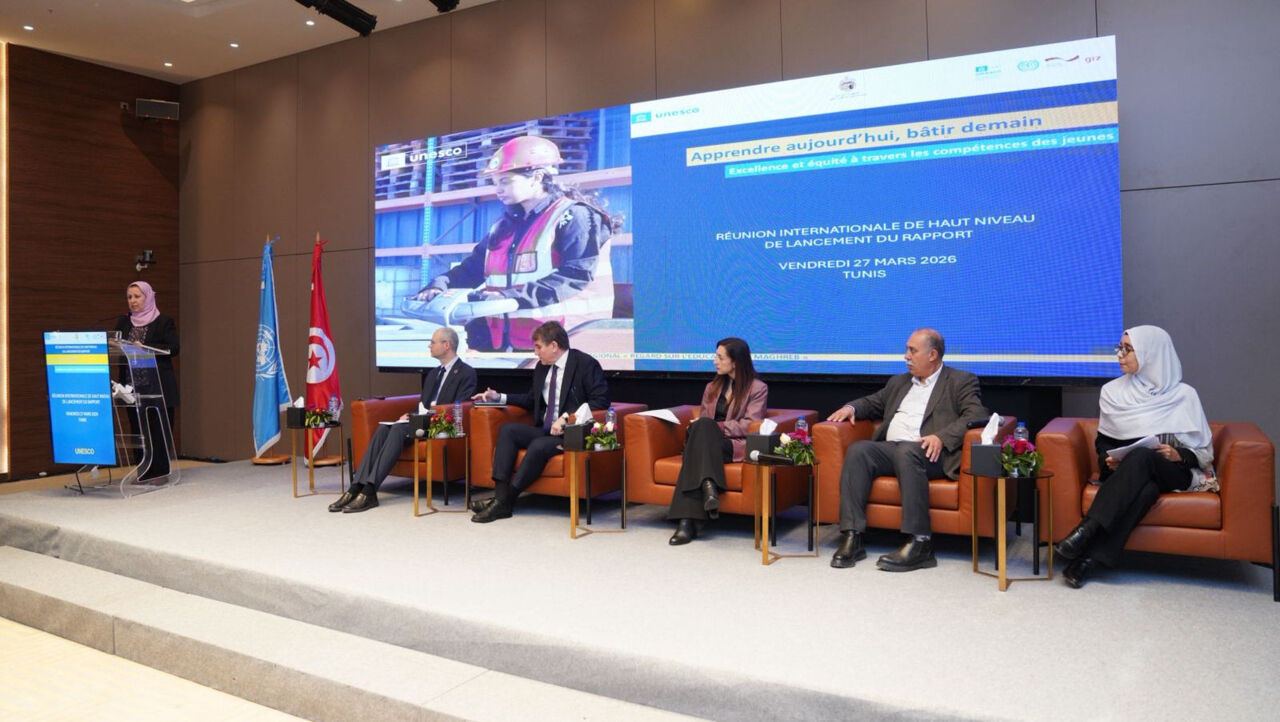
UNESCO’s Maghreb office convened a high-level international meeting in Tunis on 27 March 2026 to launch the regional report “Learning today, shaping tomorrow: Excellence and equity through youth skills”.
This is the second publication in the “A Look at Education in the Maghreb” series, which UNESCO initiated in 2024. The first report in the series focused on the digital transformation of education. This edition turns to Technical and Vocational Education and Training (TVET) and skills development for youth.
Prepared in close collaboration with the ministries responsible for TVET across the five Maghreb countries (Algeria, Libya, Mauritania, Morocco, and Tunisia) the report builds on the 2023 joint global analysis by UNESCO, the International Labour Organization, and the World Bank, “Building Better Formal TVET Systems: Principles and Practice in Low- and Middle-Income Countries.” Applying the same framework to the specific demand dynamics and priority sectors in the Maghreb, the regional report examines the capacity of TVET systems and actors to respond to those challenges, while highlighting good practices, opportunities, and actionable recommendations within the context of ongoing reforms.
The launch brought together ministers from Algeria and Tunisia, officials responsible for TVET from Libya, Mauritania, and Morocco, ministerial focal points who contributed to the report, representatives of national TVET institutions in Tunisia, labour market actors, youth representatives, and technical and financial partners supporting skills development and youth employment.
Discussions centred on how TVET systems can effectively respond to labour markets shaped by digital transformation, climate change, and the persistent mismatch between skills supply and demand that drives youth unemployment across the region. Key priorities identified included strengthening demand-driven skills development, improving quality assurance and financing mechanisms, and reinforcing evidence-based policymaking.
Yousra Assali, former WorldSkills Champions Trust representative for the MENA region, took part in a technical round table during the event, bringing the perspective of a young TVET graduate to the room. Drawing on her own experience and her advocacy work across the region, she addressed two of the session’s central questions: how to make career guidance meaningful for young people, and how to transform the perception and reach of TVET systems.
“Today, we talk about young people. But allow me to state a simple truth: young people are not only the future; they are already the present. And yet, all over the world, and particularly in our region, a contradiction persists. Young people represent a significant share of the population, but remain largely absent from the spaces where decisions that shape their futures are made,” she said, calling for youth to be involved from the outset of reform processes, and stressing that their role is essential “to express needs, to co-construct reforms, and to become ambassadors of a system they will have helped to create.”
On the state of TVET itself, she identified three structural gaps that hold the sector back, “TVET‘s high potential is affected by lack of connection, recognition, and accessibility.” Young people, she argued, want skills that are useful and directly applicable, and they want to engage with the world of work before they enter it.
She challenged the long-standing perception of vocational education as a second-tier pathway, “Training a skilled technician, a craftsperson, a competent professional is a form of excellence.” Placing the responsibility firmly on systems, Ms Assali reminded attendees that young people “are not asking for perfect solutions, but for real opportunities.”
The report “Learning today, shaping tomorrow: Excellence and equity through youth skills” is currently available in French, with Arabic and English translations forthcoming.