6 May 2026
WorldSkills is making Cooking more sustainable
From the WorldSkills Competition to the kitchen, the skill of Cooking is embedding environmental responsibility into the future of the culinary profession.
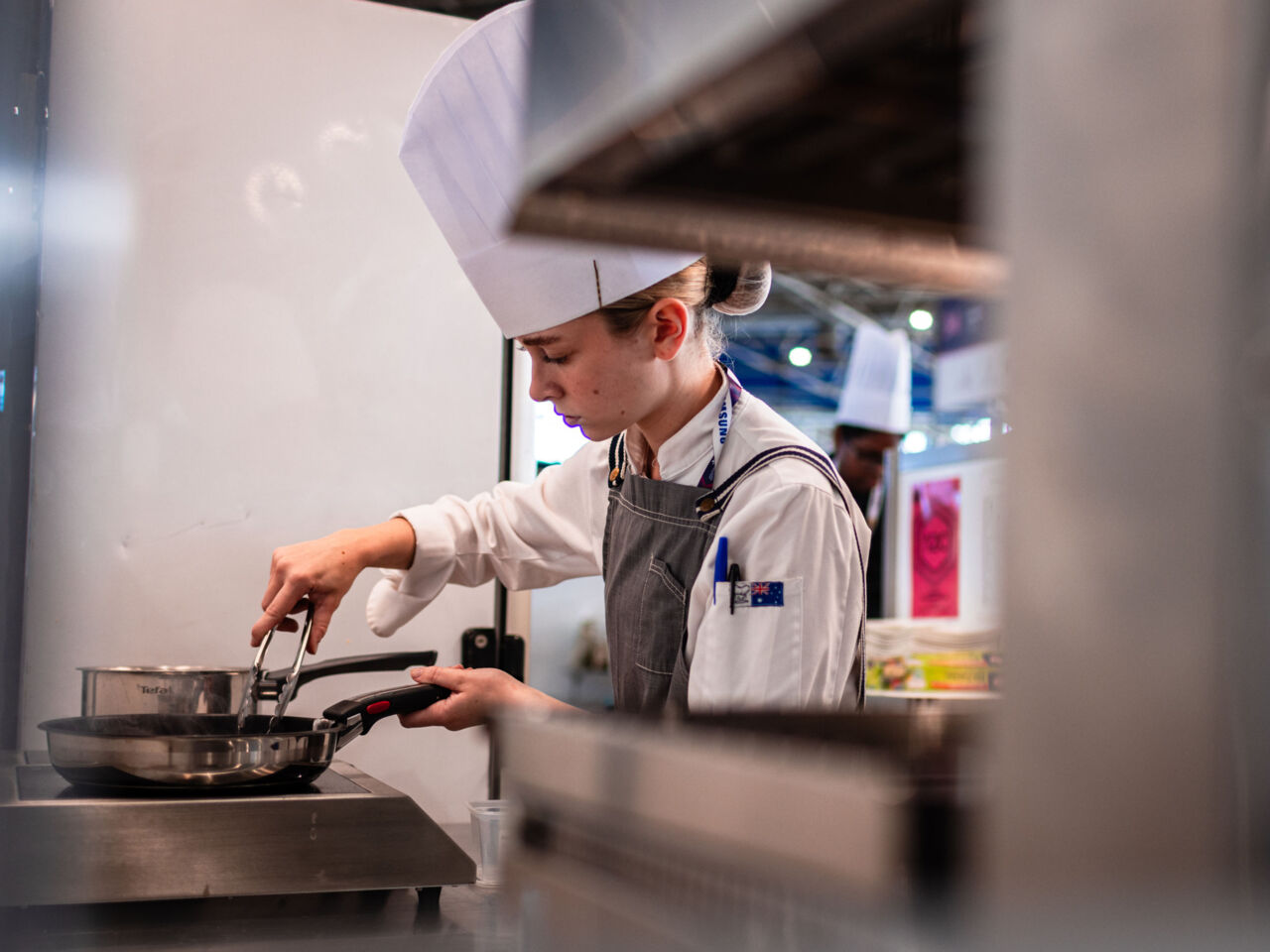
When most people think of sustainability in skill competitions, they might picture solar panels being installed, electric circuits being wired for energy efficiency, or hybrid vehicles being maintained. The restaurant industry — once associated with open flames, excess packaging, and food waste — is increasingly embracing sustainability as a core part of its operations. As a result, the Cooking skill is emerging as an ambitious sustainability laboratory within WorldSkills, reflecting a broader global shift toward greener practices in the hospitality sector.
The transformation is being driven from the WorldSkills Occupational Standards and the skill’s Technical Description, where Skill Competition Manager Sean Owens and his team have been embedding environmental responsibility into the very architecture of the skill.
As a Culinary Training Officer in the Department of Hospitality, Tourism and Events Management at Ulster University, Owens works at the heart of the Academy Restaurant in Belfast – an institution that, in 2023, became the first restaurant in the United Kingdom and Ireland to achieve Green Key certification.
Green Key is one of the world’s leading environmental award programmes for the tourism and hospitality sector, administered by the Foundation for Environmental Education. To earn it, an establishment must satisfy more than 60 mandatory criteria covering energy management, water conservation, waste reduction, staff training, and responsible purchasing. The Academy met every one of them.
Owens brings this wealth of experience on sustainable cooking into his role as Skill Competition Manager. “We are working on several projects to minimize our environmental impact in the Cooking skill competition at WorldSkills,” says Owens. “Besides rewriting and updating the Technical Description, we have reduced our carbon footprint considerably by removing the need for a toolbox to be flown around the world — a major development.”
WorldSkills Champions Trust representative for the Middle East and North Africa (MENA) region, Leyla Valiyeva, welcomes this move, as removing toolboxes has not only reduced travel weight but also “improved fairness,” she says. Addressing food waste is also “critical” to making the skill competition more sustainable. “In Competitions, waste is weighed at the end, which is actually a good indicator of awareness. Competitors are marked on it, and that encourages them to think about waste not just during the Competition, but in their future careers,” she adds, while suggesting that they explore intersections between the skills of Cooking and Restaurant Service.
Valiyeva says that sourcing is also a key area and an important aspect in her current position as private chef at the Embassy of Switzerland in Baku, Azerbaijan. “It’s important to consider the full journey of a product, from where it’s grown to how it reaches the plate,” she says. Owens has translated this directly into the skill competition, advocating for Test Projects to be written around ingredients available in the host region. Supply chain management from farm gate to plate is a core competency, not a peripheral concern, and should be part of curricula.
Owens has also pushed for a reduction in red meat in regional, national, and international competitions, and for fish to be sourced exclusively from Marine Stewardship Council-certified sustainable fisheries. He has also advocated for a plant-based module to be formally incorporated into the Test Project, alongside structured discussion of the environmental impact of different cooking methods and ingredients.
Gas cooking is out, substituted by induction, a cleaner, considerably more energy-efficient option. In many professional environments it is now mandatory for fire safety. Single-use plastics have been banned from Competitor kitchens. He also advocates for eco-friendly, biodegradable cleaning products, including baking soda and vinegar solutions, and coconut-fibre scrubbing pads rather than plastic alternatives, and for chef uniforms to be washed at 40 °C on short cycles, without chemical-based washing powder, to reduce phosphates returning to waterways. Food waste is to be separated diligently into compostable, plastic, and paper streams, with zero landfill as the target.
“We must assure chef trainers, Experts, and Competitors truly understand that the climate emergency is real and we have our part to play in reducing the impact of global cooking,” says Owens. “Identifying opportunities so we can all make a positive impact on the environment and conserve natural resources for future generations.”
With WorldSkills Shanghai 2026 on the horizon, that responsibility has a global stage. The standards, habits, and expectations set at the WorldSkills Competition will travel home with every Champion, impacting every kitchen they work in.