6 January 2026
WorldSkills Kazakhstan uses WorldSkills Occupational Standards to transform skills training systems
Over the last decade, WorldSkills Kazakhstan has strengthened its Technical and Vocational Education and Training by embedding the WorldSkills Occupational Standards into its national policies, college programmes, and assessment systems.
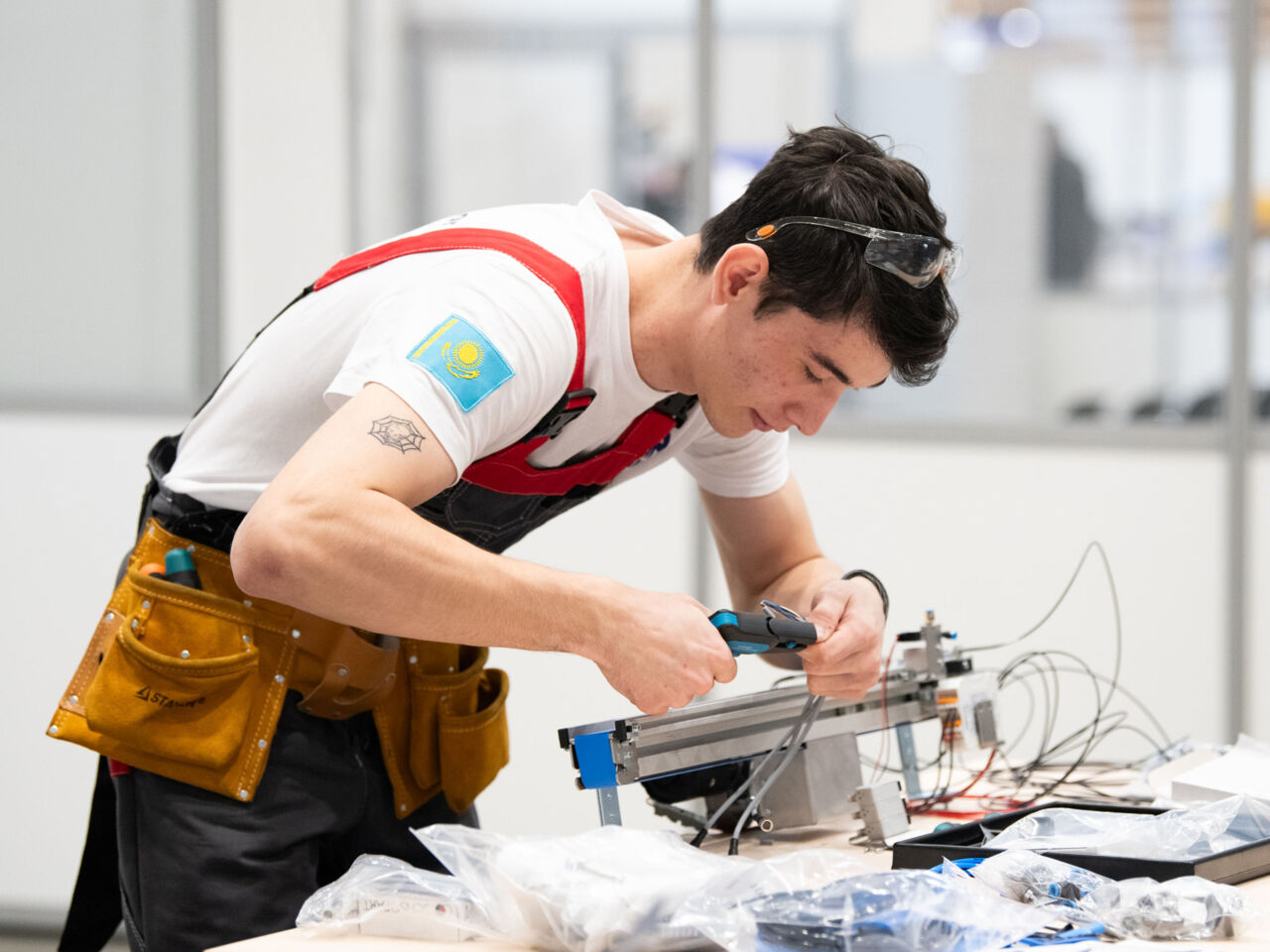
Since it became a Member in 2014, WorldSkills Kazakhstan has embraced the WorldSkills Occupational Standards, using them to build a modern skills ecosystem. As a result, it is now spearheading a Technical and Vocational Education and Training (TVET) transformation across other Turkic-speaking countries and encouraging them to use the standards to aspire to skills excellence.
Much of this success has been down to WorldSkills Kazakhstan’s proactive leadership and holistic approach. Rather than seeing the WorldSkills Occupational Standards as only a framework for competition training, it has advocated for the standards to be embedded in every aspect of TVET training, from top-down regulation, and policy to bottom-up curricula and infrastructure.
These reforms are anchored in the State Compulsory Standard of Technical and Vocational Education of the Republic of Kazakhstan, which sets the requirements for TVET learning content, outcomes, and qualification levels. These regulations specify the use of WorldSkills Occupational Standards to develop educational programmes, modular training structures, and systems for assessing students’ practical skills.
Strong government support has also led to the Ministry of Education of the Republic of Kazakhstan setting up a National Competence Centre in its capital, Astana. The centre’s programmes will be underpinned by the standards and will initially focus on economically important sectors like 5G technology, AI, digital finance, and railway signalling. The intention is to develop the next generation of young talent, strengthen cooperation between businesses and TVET institutions, and serve as a training base for Kazakhstan’s WorldSkills Competitors.
Building expert capacity is just as critical for the country. WorldSkills Kazakhstan has been working with the National Academy of Sciences of the Republic of Kazakhstan, or NAO TALAP, to develop new national training and certification programmes for its Higher College of IT and New Technologies. Instructors and vocational teachers are learning how to apply WorldSkills Occupational Standards and assessments to their everyday teaching and student evaluation. They are also connecting more closely with the international professional community and learning from other countries’ best-practice.
All this groundwork and government support has seen WorldSkills Occupational Standards become a leading framework to aid the design of training programmes, guide hands-on skills development, and monitor student outcomes. Colleges and training centres across Kazakhstan have introduced demonstration test formats and are increasingly relying on WorldSkills Technical Descriptions and training materials to ensure excellence, consistency, and transparency in training.
Investment is also being made in infrastructure. WorldSkills Kazakhstan is working closely with WorldSkills Global Industry Partners, like Grohe, and national partners, like Tikurila, to secure the quality of equipment specified by the standards. Laura Alikulova, Technical Delegate for WorldSkills Kazakhstan, says, “By actively integrating WorldSkills Occupational Standards into our TVET systems and infrastructure, we are bringing skills assessment closer to real-sector labour processes.”
She continues, “We have state support for the standards at a policy level and our national operators are busy implementing them across our colleges and training centres. They are the foundation of our educational programmes, our professional development, the standardization of skills assessments, and now, the modernization of our training infrastructure.”
This success is being celebrated in government reports, official TVET publications, and in the country’s media. National newspapers, including Kazakhstan Pravda, have been recognizing the value of the WorldSkills Occupational Standards in lifting skills achievement in Kazakhstani colleges.
In October 2025, this work led the country to host the inaugural TurkicSkills competition in Aktau. It was organized by the Ministry of Education, the Government of Mangystau Region, and WorldSkills Kazakhstan and united young professionals from Turkic-speaking countries around shared vocational standards, modern technologies, and the values of the WorldSkills movement.
TurkicSkills 2025 was the first skills competition of its scale among Turkic countries, featuring 10 skill areas across IT, construction, engineering, creative industries, and services. Sanjar Tatibekov, CEO of TALAP, described it as “an important step in enhancing the prestige of labour and strengthening the role of vocational professions in the modern world.” He recognized the importance of the WorldSkills Occupational Standards saying that “in my view, WorldSkills remains the most effective and reliable tool for promoting skills among youth.”
WorldSkills Kazakhstan’s team achieved strong results, earning six gold medals, two silver medals, and a Medallion for Excellence, and first place in the overall team ranking. The hosts also used the event as a platform to inform college directors and teachers on topics such as digitalization, green skills, and modern pedagogical technologies. Ray English, Board member of WorldSkills International, attended the event and noted that Kazakhstan showed that it has all the capabilities needed to host future WorldSkills Competitions.
David Hoey, CEO of WorldSkills International, says, “the country has expertly integrated WorldSkills Occupational Standards into its TVET system and practices. It has become a catalyst for modernizing education, strengthening expert capacity, and improving assessment systems. More importantly, it has created opportunities for young people in Kazakhstan to thrive in their careers and play a valuable part in their country’s growth and prosperity.”
Learn more about WorldSkills Kazakhstan and other Member countries and regions.